Safeguarding
Information
Safeguarding
Information Arbor
Arbor
Curriculum
Bingley Grammar School Curriculum Statement:
The curriculum and the effective implementation of that curriculum is at the heart of Bingley Grammar School, and all our decisions are built around what is best for each individual student. All students, whatever their ability, need or starting point are entitled to a broad and balanced curriculum rich in knowledge and experience. Students at Bingley Grammar School are supported to achieve their full potential and beyond through the provision of a cohesive but diverse curriculum. We make this possible by placing great emphasis on an orderly and happy working environment where high expectations are the norm. Our lessons are challenging, engaging and inspiring.
Through a well-crafted curriculum and evidence informed approach to implementation, students learn effectively and are academically successful. They develop into students who are kind, resilient, reflective and part of a community.
In order for our Curriculum to have its intended impact, we must:
- Celebrate students’ uniqueness and we promote respect for other cultures and religions.
- Value the spiritual and moral development of each student, as well as their intellectual and physical growth.
- Organise our curriculum to promote inclusion, co-operation and understanding among all members of our community.
- Value the individual needs of all of our students and strive to meet them.
- Topics are relevant to life in modern Britain, so students are prepared to be good human beings and citizens when they leave the academy.
- Ensure systematic building of knowledge sequenced to aid understanding
- Teach all lessons in a way to ensure knowledge is retained in long term memory and then can be used in the future
- Explain vocabulary that accesses the curriculum and students are supported in developing their range of vocabulary
- Ensure links are made to cultural capital, so the curriculum is made relevant and students are engaged with topics from all walks of life. Links are made across different subject areas
- Teach students the skills to apply the knowledge they have learnt
Key Stage 3 – Years 7, 8 and 9:
In Key Stage 3, students follow the National Curriculum ensuring a broad and balanced range of subjects with an emphasis on developing literacy and numeracy. Our curriculum in Key Stage 3 is designed with an academic focus on knowledge and skills needed to succeed in Key Stage 4 and 5 but also in life after leaving the school. This curriculum was designed to meet the specific needs our students. The curriculum design reflects Key Stage 2 content and builds on the foundations laid in Key Stage 2.
To achieve our vision, Bingley Grammar School is further developing a well-balanced three-year programme that allows students to study a full range of subjects including English, Mathematics, Science, Design and Technology, Food and Nutrition, MFL, PE, Geography, History, Art, Music, Drama, PSHE and Computer Science. The National Curriculum is followed in all of these subjects.
Throughout Key Stage Three we aim to build upon Key Stage two and ensure our students develop the required knowledge via a carefully sequenced design. Pupils are provided with subject Learning Journeys which allow them to see the curriculum plan and map their learning over time. We aim to ensure our students meet the highest expectations by training them to develop the skills required to be able to think like Geographers, Mathematicians, Artists, Scientists, and Historians. Each Department has its own curriculum intent which reflects the subject-specific skills and the intention for teaching these via their curriculum.
The curriculum is designed to help pupils gain the skills, knowledge and understanding that they need to become well-rounded global citizens. All our pupils take part in a wide range of activities and experiences that will help open up doors later in life. In doing so, pupils learn to recognise their own worth, develop a sense of their own identity, and take their place in the community. Pupils are encouraged to reflect on their experiences and to recognise how they are developing personally and socially, addressing the spiritual, social, moral and cultural issues that form an intrinsic part of growing up.
The school has also implemented a reading action plan for year 7 and 8 to improve reading across the school. The plan focusses on increasing the number of books read by students and supporting their reading outside of the school.
The curriculum incorporates summative assessment to support ongoing formative feedback and has a consistent principle, to be used across subjects, but the flexibility to be suitable for all.
Further details of the structure of the curriculum and subjects’ allocations in Key Stage 3 are available in the Curriculum Plan document.
Key Stage 4 – Years 10 and 11:
Key Stage 4, studied in Years 10 and 11, offers students a diverse choice of subjects to study for 2 years. These subjects are selected to further diversify the curriculum they study in Key Stage 3 and allows students to study subjects in further detail for which they have a particular passion or interest.
We highly value a robust academic curriculum so Key Stage 4 is centred on the English Baccalaureate. All students have the opportunity to study both a Humanity and a Language, leading to completion of the English Baccalaureate. We believe strongly that the pathways are used to support students in the option process, and guide student choice rather than dictate it.
Further information regarding the pathways is available in the Curriculum Plan and in the Options section of the website.
Key Stage 5 – Year2 12 and 13:
The curriculum is built with our students' aspirations in mind, giving students the opportunity to study complementary qualifications preparing them for future careers in a variety of different settings such as STEM or Clinical Care.
In addition to high quality delivery of qualifications, our Key Stage 5 students benefit from an enrichment programme ensuring they leave us prepared to face the challenges that lie ahead. Fort the majority of our students, the curriculum is enhanced even further with the opportunity to study the Extended Project Qualification as well as a bespoke package of support, aiming to secure the highest grades possible.
Assessment:
Clear regular target setting, assessment and reporting systems underpin all aspects of learning throughout the school so that students understand the progress they are making and how to make further improvements. Academic data is collected 3 times a year to “Track” how well students are achieving against their targets. More importantly the assessments are then used to assess gaps in knowledge so teachers can then intervene to plug these knowledge gaps through a range of strategies such as targeted intervention and feedback.
Our intent for the curriculum at Bingley Grammar School is to offer a broad and balanced curriculum which engages, challenges, inspires and prepares all of our students for the future. We place the student at the heart of our curriculum and strive to offer a personalised learning experience, in which we are able to discover and develop the talents and abilities of each and every student in our care.
Our broad and balanced curriculum reflects our commitment to encouraging confident, independent learners. There is a clear focus on developing a reading culture and metacognitive strategies across all year groups so that students can develop transferable skills which will support them to become lifelong learners.
A range of progression routes is in place and inclusive for all pupils to ensure that they are provided with the opportunity to grow, develop and realise their potential.
The school's curriculum is planned and sequenced to ensure a smooth transition between Year 6 and Year 7. We build on our students’ knowledge and skills and lay the foundations to enable them to broaden and deepen their knowledge and understanding in Key Stage 3 continuing into Year 10 and beyond when they specialise in their core area and chosen subjects.
Students follow the National Curriculum through this broad and balanced approach and are provided with the opportunity to study a wide range of subjects. The knowledge-rich KS3 curriculum demonstrates progression in structure, setting out what we want our students to learn and therefore the progress we expect them to make in developing and refining their knowledge and skills.
The whole school Curriculum develops students for the next phase of education, training or employment. The Curriculum also develops and deepens the Social, Moral, Spiritual and Cultural focuses, as well as the British Values and Cultural Capital already established within the reviewed curriculum.
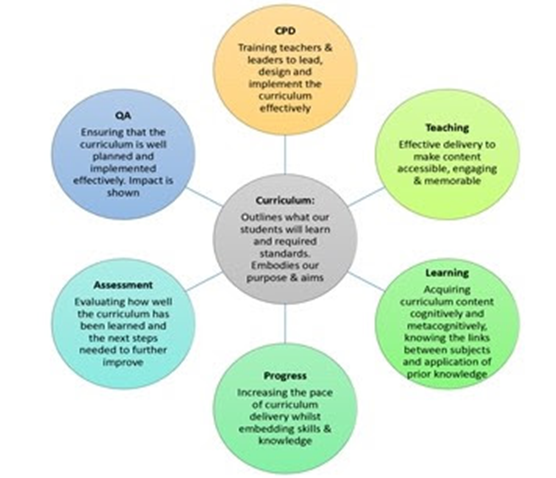
The diagram below shows the different aspects of implementation which support the effectiveness of our curriculum:
Quality Assurance (QA) of the Curriculum:
At Bingley Grammar School we believe that quality assurance provides us with the ability to deliver our curriculum intent, at both school and subject level, in the most effective way. Subject QA looks at the following broad areas of practice:
Curriculum Intent:
- Does the subject intent align with the school aims? Has this been effectively defined and communicated to all relevant stakeholders?
- Are our teachers absolutely sure of what our students are expected to know as a result of precise and detailed itemisation of curriculum objectives?
- Can our subject leaders and teachers explain the curriculum rationale and why it is appropriately challenging? Is there obvious depth of thought regarding selection and sequencing of content?
- Is curriculum coherence effective? Do all parts of the curriculum work towards a common goal?
- Are we ambitious about delivering our intent to all students?
- Is the curriculum consistent? Are all teachers delivering the same curriculum and giving all students every chance of learning it?
Curriculum Implementation:
- Do our QA activities show curriculum intent is being followed?
- Does the CPD curriculum demonstrate time allocated for curriculum development?
- Does our student voice show effective curriculum implementation?
- Does our appraisal process monitor curriculum intent, implementation & impact where appropriate?
- Is internal and external assessment data effectively used to monitor implementation?
Curriculum Impact:
- Does internal and external assessment/results data show effective implantation?
- Is positive curriculum impact supported by the Inspection Data Summary Report (IDSR)?
- Does our student voice show effective curriculum impact?