Safeguarding
Information
 Arbor
Art & Design
At Bingley Grammar we aim to teach students how to be independent learners; to be creative, to develop critical analysis skills, to be reflective practitioners, to cultivate self-discipline and to be intrinsically motivated.
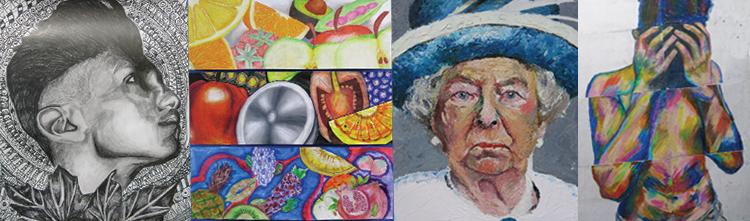
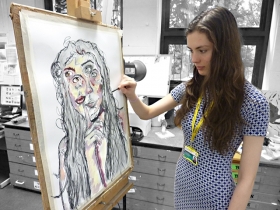 The Art and Design department aims to provide a broad and enriching artistic experience through the study of a wide range of image making styles, materials and techniques. Students will learn and apply visualisation skills, research and analyse the work of other artists, develop creative thinking and problem solving skills and learn how to experiment in order to realise their ideas and achieve successful outcomes. Students are encouraged to take creative risks and to be as imaginative, creative and original as possible when applying the skills they have learned.
Image making skills are practiced and developed at KS3 through schemes of work that are accessible yet challenging. Portraiture, landscape art, the birth of abstraction, non-western art, street art and sculpture with recycled materials are among the topics covered. Students are asked to use unfamiliar materials and think about new and exciting approaches to the subject. Research exposes them to a variety of interesting Artists – both traditional and contemporary - that demonstrate a chronology of artistic ideas that puts Art and Design into a context that students can understand and be challenged and inspired by. Fine art, sculpture and printmaking all feature as key elements.
Useful Resources and Revision Support
Link to Specification
AQA Resources
Tate Modern
https://www.tate.org.uk/visit/tate-modern
National Portrait Gallery
https://www.npg.org.uk/
Recommended Art & Design Books:
Wider Reading List - Art & Design
Assessment
KS4 Exam Board Specification: AQA GCSE Art and Design: Art, Craft and Design
Link to Specification and mark scheme:
AQA-ART-GCSE-SP-2016.PDF
Enrichment
The department runs Art Club on Mondays after school where students in all years have the freedom to create personal work and experiment with different materials. We also offer subject specific support sessions for students in Years 10, 11, 12 and 13. We hold art and photographic competitions and encourage our students to engage their creativity.
Curriculum Overview
Year 7
- Tone and Form
- Gradients and 3 dimensionality
- Collage and perspective techniques
- Pattern and Colour
- Colour mixing
- The various ways to apply paint
- Poly-print
- How to understand and use the art of another culture in their own work
- Stylize and Exaggerate
- Develop observational skills
- Proportion and Scaling
- Understanding the work of other artists
- Experiment with colour
Year 8
David Hockey Landscape. Students explore various painting methods and colour theory alongside studying the landscape painting of David Hockney.Develop Art terms and language
Viewpoints and Cubism
Explore a variety of materials – including oil pastel sgraffito, mixing and blending paint, developing pattern and using collage to explore, refine and develop ideas of overlapping viewpoints
Students look at the traditions and cultural significance of totem poles and work collaboratively to create a cardboard relief section of a totem pole.
Year 9
Workshop skills:
Students develop their knowledge, skills and understanding through the exploration of portraits. They use oil pastel, collage and printmaking and use a variety of artists to take them through a range of conceptual and practical approaches to portraiture.
Street Art:
- Develop Art terms and language
- Explore a variety of materials and techniques – including collage, different kinds of drawing and painting
- To explore, refine and develop ideas through looking at the work of others.
Year 10
People:
Students will gain greater understanding of how contemporary artists work by looking at a young local artist's practice, generating their own source imagery to work up a large scale acrylic painting.Built environment:
Students gather source material to respond to the theme of the Built Environment, looking at Vorticism and the artists Iain Murphy drawing materials and techniques.
Year 11
Journeys:
Students work with increasing independence to respond to the broad theme of ‘Journeys’. They pick and develop their own personalised response, sourcing images and ideas and looking at a wide variety of approaches including the layered multimedia work of Robert Rauschenberg.Controlled Test - Personal Exam:
Take a starting point from their GCSE controlled test paper.They will produce research pages that demonstrate an understanding of how a variety of artists have approached their chosen topic.
Students will explore, develop and refine techniques appropriate to the chosen topic. They will record relevant ideas and insights through annotation, drawing and photography where appropriate
Students will present a personal and meaningful response to their chosen theme that demonstrates an understanding of the work of others and meets intentions.